

Every executive team worships KPIs. Hit €15M in revenue. Accelerate delivery with AI. Grow top-line by 30% next year.
Almost none track the metric silently eating those gains alive: the Key Loss Indicator (KLI).
On €15M in revenue, losing €100K to a bad hire is operational pocket change. Nobody loses sleep over a rounding error. A KLI is never about the isolated incident. It is about compounding structural drag.
Revenue scales linearly.
Internal friction scales exponentially.
You do not even need to step inside a boardroom to spot a KLI. You can read it straight off a company’s public job postings. When a growing tech company launches a desperate search for a “VP to bring structure” or a “Delivery Manager” to rescue projects, they are rarely hiring for growth. They are hiring an expensive human band-aid to cover an executive bottleneck. (I regularly deconstruct these exact architectural leaks in public job postings on this Substack.)
KLIs do not measure intentions, slide decks, or leadership values. They measure the financial bleed caused by how the executive team actually behaves under pressure.
In a growing IT organization, three compounding KLIs show up almost every time:
1. The 6:14 PM Leak (Decision Latency) When pressure rises and the executive team commits an emergency overrule, the organization learns a simple lesson: autonomy only exists on quiet days. Teams stop making calls. Every operational choice bounces back up the chain, landing in the CEO’s inbox after hours for final approval. At 20 people, you can carry that weight. At 80 people, you become the hard ceiling on growth. Hiring more senior specialists onto a broken decision architecture does not multiply output. It multiplies the requests hitting the exact same bottleneck.
2. The Toxic Hostage and Consensus Loop (Margin Erosion) To keep the peace, Management Teams routinely protect a high-performing saboteur or postpone hard choices until “everyone is on the same page.” Stretching a two-hour decision into a six-week consensus loop seems harmless once. Repeat that across four execution cycles, and your 12-month strategic plan turns into a 16-month slog. You are not just wasting meeting hours. You are burning four extra months of full-company payroll just to avoid executive discomfort.
3. Technical Silencing (Architectural Paralysis) When executives treat core solutions as their personal territory and bypass domain leads and architects, senior specialists get reduced to passive executors running at 20% of their cognitive capacity. When your sharpest builder eventually walks out, the real KLI is not the recruitment fee. It is nine months of architectural paralysis while competitors take your market window.
The Silent Tax on Profit and Valuation None of this shows up as a separate line item on your P&L, yet it explains the single biggest frustration in modern IT leadership: top-line revenue grows, AI tooling speeds up execution, and yet bottom-line net profit barely moves.
On €15M in revenue, €1.5M in delayed delivery, rework, and silent EBITDA leakage wipes out a massive chunk of your operating margin. And if you ever look toward an acquisition, succession, or exit, that missing €1.5M in EBITDA quietly destroys €9M to €12M in company valuation.
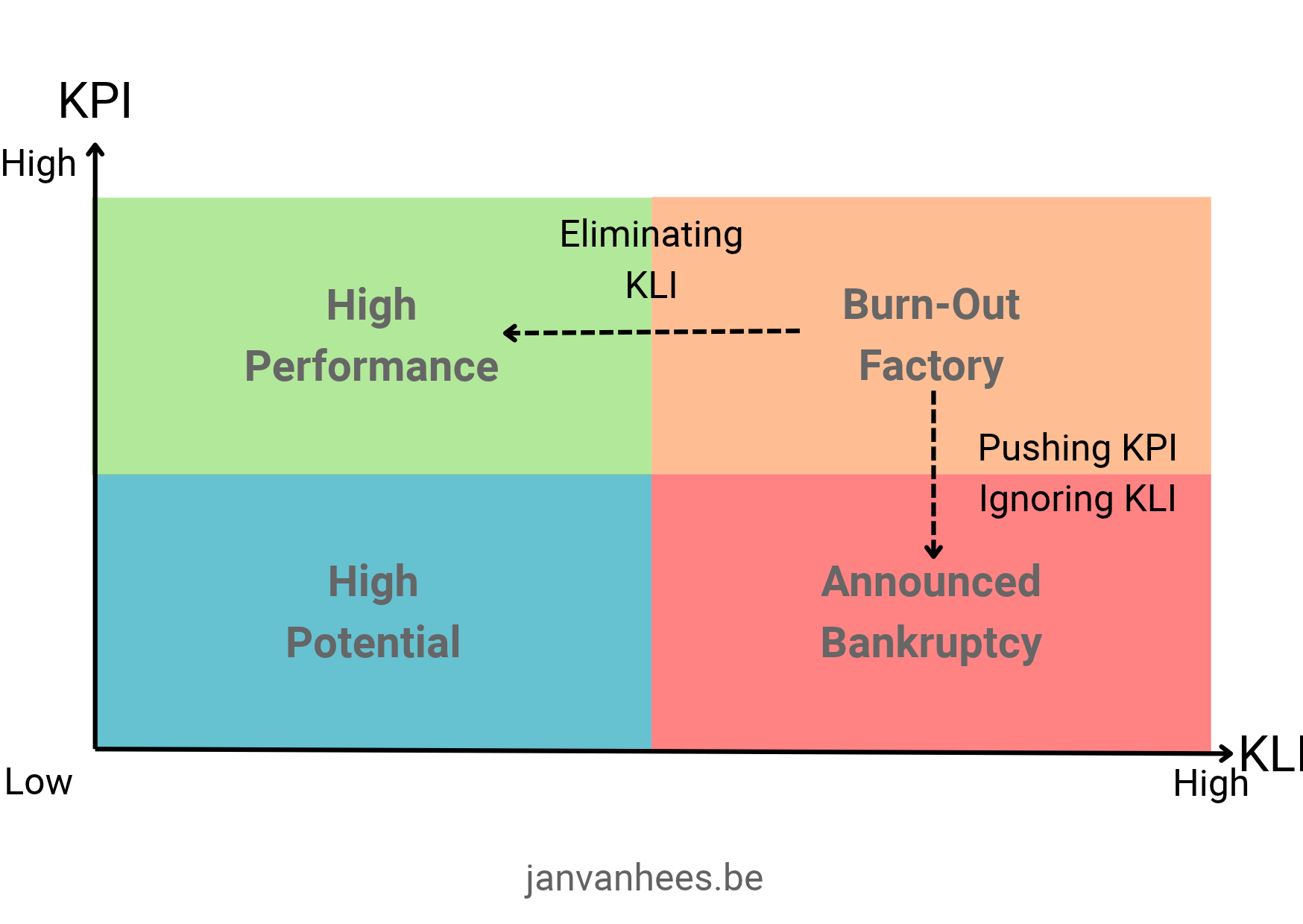
Most growing companies sit trapped in the top-right quadrant of the matrix below: the Burn-out Factory. High revenue, relentless activity, and massive internal friction. The standard reflex is to push harder on KPIs or throw communication workshops and agile coaches at the floor. That never moves a company into High Performance. It simply accelerates the slide straight down into Announced Bankruptcy.
You cannot fix an executive bottleneck by training the people below it.
KPIs determine how much capital enters your company.
KLIs determine how much of it actually stays.
Want to see how visible these leaks are from the outside? Read my public Vacancy Deconstructions on this Substack.
Ready to run a clinical check on where your own leadership architecture is leaking Enterprise Value? Start at https://scan.janvanhees.be
.